The Coal Yard & other stories

Page 8

PETROL

In the early days of motoring, Grandad (Bill) Ellis needed to have petrol for his trucks and to supply the local vehicles. The fuel came in wooden cases each with two 4-gallon tins of “Plume” petrol. (Nowadays known as Mobil) This highly inflammable mixture was stored in a tunnel or cave that had been dug out of the clay bank beneath the bench that stored bags of coal at truck height. Later the first “Bowser” was installed along with an underground tank. This bowser had a crank handle that had to be wound round and round. Following this a new model with a lever was installed. Pumping the lever lifted the fuel up into a glass jar above head height. When this jar was full it flowed into the vehicle through the delivery hose, while a second jar filled, to keep the flow continuing. The novelty of “pumping” the lever back and forth soon wore off, yet next time a car or truck came in, we were all crying out to Grandad to “let’s have a go”.

After the Second World War when petrol was rationed, an Inspector came to check that the petrol use was in keeping with the quota. Bill Ellis never let anyone get cold through lack of coal and many desperate calls were made for extra petrol also. Although petrol was always paid for, (coal was often given free to poor and starving families) The tank level in this instance was lower than the coupon system allowed. Fred Ellis (the oldest son) returned to the yard to be The old “Bowser or pump” met by his sister Winnie. “Dad is in serious trouble” she cried.
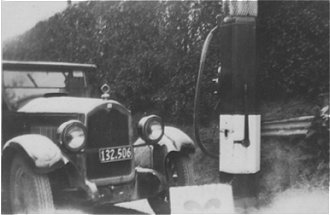
The old petrol Bowser
The old petrol Bowser or pump.

“What can we do?” Fred quickly added several gallons of water to the tank before racing down the road to catch up with the Inspector. Together they returned to re dip the level. “Our tank has a leak that lets water in and petrol out,” said Fred. The Inspector arranged for a new tank and the problem was solved. After that, Bill was careful only to sell petrol if the correct coupons were produced.

At the back of the “yard” (coal yard at KV. Rd.) the family kept a few hens. Mrs. Rodgers from next door complained that they attracted flies. Grandad got rid of the hens but the flies still came around. Mrs Rodgers had been throwing her old meat scraps over the hedge into the paddock, which was what brought the flies. The Rodgers family came from the Owaka area. Wattie Rodgers drove a Bakers cart. A son, Stanley became a Member of Parliament.

Other big Buildings

Along the valley road there were several two storey buildings. Some were houses on the bottom side of the road where the hill dropped down to the Kaikorai Stream. These houses had the lower storey below the road with the front door entrance at street level. At the bottom of Falcon Street was Hunters Store with the cable car going past one side. Mr. Hunter carted the newspapers to the various paper boys who had set areas to cover. Jim Thompson recalls being one of these boys, calling out “STAR” as the walked around the streets.

Go to Next Page

Go to Page 1 - 2 - 3 - 4 - 5 - 6 - 7 - 8 - 9 - 10 - 11 - 12 - 13 - 14 - 15 - 16 - 17 (last page).