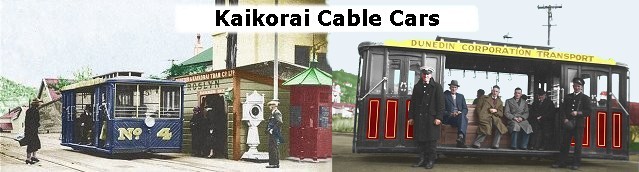
The Kaikorai Cable Car Line |
|
The first cable car to run on the Kaikorai line was on 9th October 1900 and the last car ran from the Octagon to the sheds at 11.10pm on Friday 31st July 1947. The first five cable cars were (strangely) numbered 1 - 5. They were built in 1900, weighed 5 to 6 tons and had the following dimensions: Height: 8 feet 9 inches (2.7 metres), width: 7 feet 10 inches (2.4 metres), length: 19 feet (5.8 metres). A sixth cable car (No.6) was started on the line about 1938 having been built by the Dunedin & Kaikorai Tramway Company with virtually identical size and weight as the first five. The cars were renumbered 121 thru 126 by the Dunedin City Corporation Transport in 1939. To the observer, the difference between the first five cars and the last was that No.126 had a more rounded roof, with the front and rear windows being three panes wide rather than five like the others. However, looking at some photographs it appears other front and rear windows may have been changed to three panes in later years. The driver of a cable car was called a 'gripman' which was no doubt due to the way the cable car functioned. With a rope travelling along continuously under the tracks, the gripman operated a large lever which went down under the car to below the centre tracks to allow it to connect, or grip, the rope (cable). Once the cable had been 'gripped' the car would travel along at 12.8 kilometres per hour (7.95 miles per hour). The gripman was able to adjust the amount of pressure that was used to grip the rope by means of a wheel about 6" (150mm) in diameter - this was mounted near the top of the gripper lever. See photograph. Visit Dunedin Trams web site at http://www.dunedintrams.co.nz/ which among other things is looking at the possibility of restoring an operational cable car route in our city. |
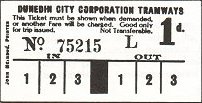 A 'section' on the cable cars cost one penny. Jim Sharp, now aged 92 years (2006) was frequently the gripman on No.4 cable car - he has provided some interesting information relating to the early cable cars. Jim is also an amateur radio operator, ZL4DN, and has been since 1938. The cable car brakes consisted of metal shoes on each of the four wheels and an additional brake that pressed down on the rails. The gripman (driver) did not use this additional brake if the car was about to travel over a hump like the transition from Highgate to the incline to the city - the reason was that the car would be lifted up as it went over the 'hump'. When braking in wet weather the wheels would not grip the rails very well - sand could then be dispensed by the gripman from boxes situated under the seats in the front and rear compartments. Our next door neigbour, in Jellicoe Crescent, Len Kitto was a conductor on the Kaikorai cable cars. 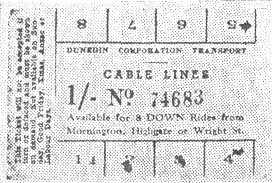 Pictured above is an 8 trip ticket for the Dunedin Corporation Transport Cable Lines, "available for 8 down rides from Mornington, Highgate or Wright Street." at a cost of 1/- (one shilling or 10 cents in today's currency). Strange that, the Kaikorai line went to the city via the top end of School Street, Wright Street is one further to the North!!!! View more cable car photographs |