
Transport Modes - the Morris Minor and others
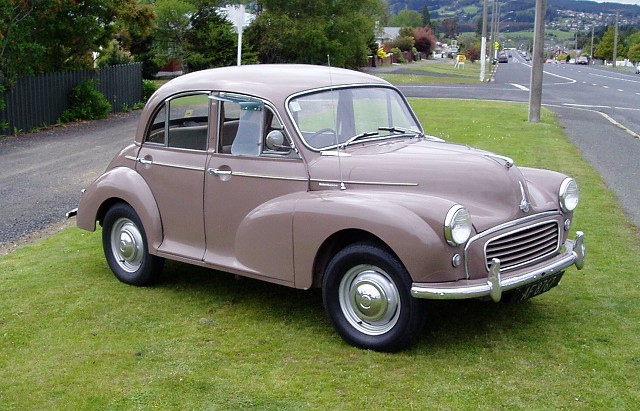
Photo by Alan Gilchrist courtesy of the proud owner since new - he lives locally.
At this time Wooff & Salvesen (Dn) Ltd, where I worked, were agents for Lucas automotive electrical parts among other agencies. They had the task of doing 'Lucas Checks' on all new English vehicles imported by the Dunedin car dealers. Basically this entailed checking all the electrical system including the settings of the voltage regulator for the generator, electric wiper operation and so on.
On the up side of this routine task was the fact that we often had to return vehicles to the various dealers, thus giving us a good grounding in the behaviour of all the latest vehicles being imported by local dealers. I can recall driving International Harvester tractors up through the Exchange to return them to the dealer in Stafford Street - in today's terms 'is that cool, or what'?
This was the age of Morris, Austin, Hillman, Humber, Standard 8 and 10 and the Vanguard, the Triumph Mayflower, Jaguar, Riley, Jowett Javelin and the Bradford van (by Jowett) which had a horizontally opposed two-cylinder engine, Wolseley, Daimler, English Ford models (Prefect, Anglia, V8 Pilot) and so on. The new shapes of vehicles were in vast contrast to the old square box design and for years prospective buyers had to wait 12 months or more after ordering to gain delivery. The dealers could only import if they had signed up orders for the cars. You don't see a lot of these cars any more and the best of those that do survive are probably cared for in collectors 'stables'.
Trafficators (semaphore type direction indicating arms) or 'wig-wags' were common until the 1950s when flashing direction indicators started to appear on the newer models. The installation of flasher kits became a common job for us at that time. The old trafficators sometimes used to stay sticking out after they'd been turned off with a consequence of being broken when the driver or front seat passenger got out of the car and moved backwards to close the door - goodbye trafficator arm!!!!! The other annoying thing about trafficators was, you'd take them out of the car if they were inclined to stick, clean and service them - working 100% - but on reinstalling they would again stick in the 'up' position. A good reason to have flashing indicators in my opinion.
For a few bits more on the Morris Eight and Morris Minor versions check the Next Page.