The Maori Hill Electric Trams

Reproduced from the Dunedin newspaper "The STAR" of 4th October 2000

electric trams header

October 23 2000 marks the 100th anniversary of New Zealand's first electric tram service, the Roslyn Maori Hill electric tramway.
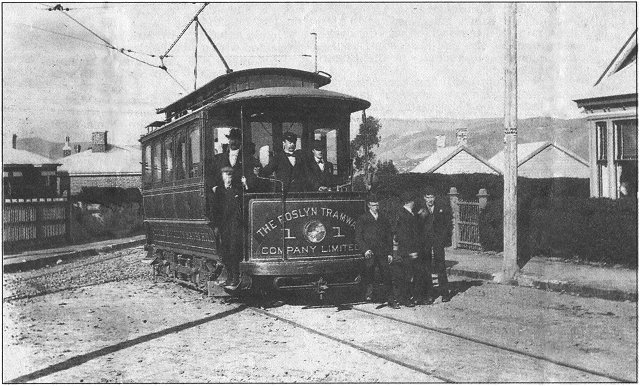
Electric Tram at Maori Hill
Roslyn Tram No.1 leaves the Spylaw St tram sheds on one of the first trips
(possibly a staff training run) along Highgate to the Junction on October 23, 1900.

Photo: Alexander Turnbull Library.

The Roslyn Maori Hill trams predated the Auckland system by two years and the Dunedin City Corporation's tramways by three years.

The three trams first used on the Roslyn to Maori Hill line were built by the J.G. Brill Co in Philadelphia in 1899-1900 and shipped to Dunedin on the Westralia.

The Dunedin and Roslyn Tramway Co, which had opened the first street cable tramway in the southern hemisphere in 1881, was in financial strife in 1900 and tram number three had to stay in its packing case on arrival in Dunedin until the company could pay for it.

The company was facing severe problems with its cable line. A new extension had just been opened from the Junction (near the foot of Ross St) to Kaikorai Valley via James (now Falcon) St and the Public Works Department had ruled that the portion of the line from the top of James St to Kaikorai Valley could not be used because of a dangerous corner where cable cars "dropped" the rope to coast around the corner and were then required to "pick up" the rope on the very edge of a steep slope down to the valley.

To add to the complications, a rival cable car company, the Dunedin and Kaikorai Tramway Co, had built a line on Stuart St to Kaikorai Valley crossing the electric line on High St (now Highgate) by the site of the present Highgate bridge which they also planned to open in October 1900.

However the Exchange area was then the shopping centre for Dunedin and the electric line provided a convenient connection with the Rattray St cable car at the Junction.

A series of technical problems with the Stuart St cable car saw the opening for passenger traffic delayed from October to December 23, 1900, giving the new electric trams a two months start to garner the passenger traffic along Highgate.

The new electric line followed the route of a previous horse tramway from the Junction via reserved track on Scarba St and up City Road and along Highgate. The horse tramway had terminated at Bishopscourt now the site of Columba College, but the electric tramway continued along Highgate to a terminus at Drivers Rd.

The tram sheds were on the corner of Spylaw St and Highgate some 300m north of the terminus. Trams did not take passengers as far as the sheds although a "car stop" sign on a pole opposite the sheds on opening day suggests that a service may have been offered that far for a time.

The only loop line on the route on the downgrade between Selkirk and Fifield Sts on Highgate allowed the northbound and southbound trams to pass. The loop was technically challenging. There was only one overhead electric wire and the northbound tram conductor had to pull down the pole from the wire while the tram coasted at speed 'American style" on to the loop on the right-hand side of the road. Only two trams could be operated on the line.

The fast (30kmh) and frequent service (every seven and a-half minutes in the peak hours) attracted large numbers of passengers. Some people travelled only short distances. Lylee Donaldson of Palmerston, whose father, Henry Thompson, worked on the Maori Hill trams, first as a conductor and then as a motorman, remembers one lady who would regularly travel up Rattray St on the cable car to the Junction and ride on the Maori Hill tram along Scarba St to the Leven St stop just a few metres along the street.

Difficulties arose in the years after World War 1. Peak-hour trams had aptly named "Crush loads". The Dunedin and Roslyn Tramway Co was not in a position to double track the tramway and sold out its electric tram and cable operations to the Dunedin City Council in 1921.

DCC Tramways manager W.H. McKenzie, in an annual report to the city council, described the delays at the loop caused by heavy loading and the steeply graded section of track between Claremont and Pacific streets as "Vexations". Two larger Brill trams from the City Tram Depot were exchanged with two of the original Maori Hill trams to help cope with the increased passenger traffic.
Plans by City Tramways to extend the Maori Hill line down Drivers Rd and Pitt St to the city lines in George St were technically feasible - Pitt St was just within the limit of adhesion for electric trams.

A horrified Public Works Department - which had the final say on safety on any new tramway system - ruled out the extension. They feared a runaway tram roaring down Pitt St to an inevitable major accident on George St.

The tramways department, desperate with the problems of overloading and delays on the Maori Hill line, even considered in the early 1920s the possibility of building a cable car line on Pitt St. The capital cost of 436,000 pounds ruled this out.

Salvation of a sort, was in sight. Petrol buses had become more reliable since the days of the Elgin Rd charabanc - the first municipally-owned bus in New Zealand. Twenty petrol buses - Reos and Grahams - were purchased by the council's tramways department to augment the tram service during the Dunedin and South Sea Exhibition in 1925-26. One of the first routes the buses were tried out on was from Pitt St to Maori Hill.
Recognition urged

The author of this article, Bill Campbell of Palmerston, is a free-lance writer with an interest in Dunedin's tramways history.

He says it would be good to see some recognition of the Roslyn Maori Hill electric tramway, one of the features in Dunedin's rich public transport history.

"At the very least a plaque could be installed at the Maori Hill terminus. Even better, a full working restoration of Maori Hill No.1, New Zealand's first electric tram, could be undertaken.

"It would be great to see Maori Hill No.1 tram running again on a Dunedin street - if not on Highgate then perhaps the Exchange, George St, university, railway station, Early Settlers Museum circuit being advocated by the Dunedin transport 'ginger group' Project Cable Car/Tramway could be considered.

"Such a line would be useful for students and Dunedin shoppers and workers as well as a major tourist attraction."
 

The new buses were a great success. They relieved the overloading on the Maori Hill trams at a fraction of the cost involved in a tramway or cable car line down Pitt St. A direct service could be provided for Maori Hill people to the exhibition at Logan Park.

From 1929 the more lightly patronised Sunday tram service from Maori Hill to the Junction was replaced by the "Exhibition buses", as they were fondly named by Dunedin people.

The tram service came under threat of closure. Passenger numbers dropped with the Depression of the 1930s. The Brill trams were wearing out and the tramways manager lamented in his annual report that parts were unobtainable.

The single track tramway ran on the western side of Highgate in both directions and the loop line ran "American style" with northbound trams running on the right-hand side of the street, posing a hazard to the increasing car traffic.

Economies were introduced - one conductor was withdrawn and the remaining conductor would take fares on the northbound tram from the Junction to the Fifield St loop and then travel back on the other tram.

A "rail-less tram" (a trolleybus) was considered for the Maori Hill line in 1931 but a heavy government-imposed road tax on trolleybuses put paid to that idea. Trolleybuses did run between Maori Hill and Rattray St between 1954 and 1972 after the completion of the Highgate bridge.

Experiments with the new Leyland Tiger diesel buses introduced in 1935 were successful on Dunedin's hills and it was decided that the Maori Hill trams would be replaced by diesel buses from July 1, 1936.

The last tram to Maori Hill ran at 3.07pm from the Junction after connecting with the 3pm cable car from Rattray St. The last tram was started by transport manager W.H. McKenzie and then driven by ex-inspector Woolley who had been a motorman on the first day of service in 1900.

Significantly, the two Leyland Tiger diesel buses passed cable cars on Rattray St as they travelled uphill to take over the Maori Hill service. Cable car services would be the next to be replaced by the diesel buses.

The Maori Hill trams had their share of stories. One motorman, "Hellfire Jack" Peterson, used to set the tram controller to "full parallel" ("flat out" in layman's terms), put his feet up on the controller and take swigs of cold tea from a bottle. This had interesting effects on his passengers, particularly in the early days of the tramways when passengers came from all around Dunedin, amazed at the new electric trams and somewhat fearful of their speed and the dangers of electricity.

The line had its share of accidents. The trams which were fitted with the slower- acting magnetic brakes rather than the airbrakes common on other systems took an effort to stop, particularly on the sharp down grade along Highgate.

Lylee Donaldson recalls the day when a small boy ran out from the Dunblane St corner as a tram was descending the hill. The boy fell underneath the tram. Fortunately he was caught by the cowcatcher and the tram's motorman, Jack McLeod, was able to stop the tram in a very short distance.

The boy had only minor injuries. The possibility of major accidents always worried the tramwaymen. Jack McLeod never drove a tram again.

One Saturday afternoon in May in the 1930s both trams were stopped at the loop by Selkirk St. It was the quiet time of the afternoon and a local household had invited them in for a cup of tea. When they emerged only one tram remained on Highgate - the southbound tram had vanished.

It was Capping Week and students had hijacked the tram. It was found on the grassy verge by the Scarba St corner, having run off the track helped by a fast- driving "student" motorman!

A collision between a tram and a Kaikorai cable car at the Highgate crossing led to alarm bells being installed. Trams had to give way to the Kaikorai bound cable cars.

There were also the usual high-school-age pranks. High school boys standing on the back platform of the single truck Brill trams would jump, up and down to try to derail the tram. There are no reports of their being successful but such incidents probably accounted for the state of war that often existed between the tram crews and the high school pupils.

Today, Maori Hill No. 1, the first electric tram to run in New Zealand, is being preserved by the Otago Settlers Museum. Tram No. 3, another of the original 1900 vintage trams to run on the Maori Hill line, is stored at the Tramway Historical Society tram barn at Ferrymead in Christchurch. Both trams could be restored to become fully operational again.

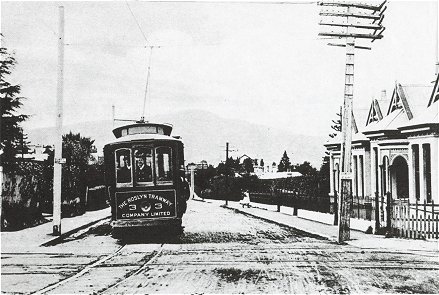
Electric Tram at HighgateGraham Haase
Above: The Maori Hill to Roslyn tram at the High St (now Highgate) cable car crossing in 1910.
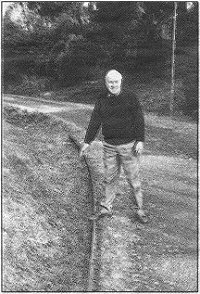
Right: Graham Haase, president of the Dunedin Project Cable Car Tramway Group stands by the only remaining rails from the Roslyn Maori Hill electric tramway, which are still set at the road edge on Scarba St near the former terminus at the Junction. Photo. Bill Campbell.

Maori Hill Trams Index or Next Page