
Roslyn Scouts - Meeting Places
BUILDINGS
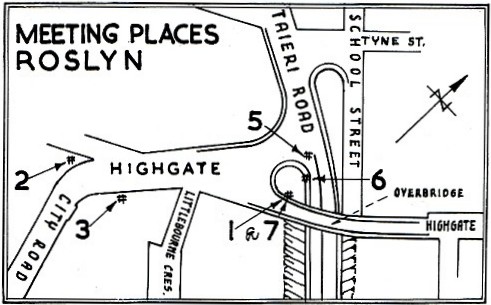
In 1915 the troop moved again, first to WEBSTER'S BOOTSHOP (5) and not long afterwards, in 1917, to the old VOLUNTEER FIRE BRIGADE GARAGE (6). Both these buildings were just below Washer's Hall on a site now covered by the highway.
Apparently the year of the troop's foundation should have read 1909 in this article.
With the formation of the first committee in 1918, the use of WASHER'S HALL (7) was again secured, and by 1920 the troop had made its final move to the Coronation Hall, Maori Hill. So ended the twelve years' close association with the Roslyn township and thus is explained the enigma of a Roslyn Troop which meets today in Maori Hill.
Scouts and Cubs of past years and of the present and future owe a debt of gratitude to the foresight of William Garden, the then Scoutmaster, who conceived the idea of levelling the Coronation Hall basement. It was under his guidance with pick, shovel and barrow that the task was roughly completed by the end of 1923.
The subsequent history of our Scout Den is one of periodic improvement. Using wood from the Dunedin and South Seas Exhibition in 1926, the Committee and Cub rooms were added, and soon after four patrol dens erected at the south end. Few Scouts and Cubs of those days will forget the tannin bark spread over the rough clay floor, the consequent dust, the all too frequent puddles, and probably, too, their parents' opinions of the state of uniforms after each parade. The last of these may well be the reason for the dismantling by 1929 of the original patrol dens and the asphalting of the whole floor area (repeated 1935).
In 1930-31, under Scoutmaster George Coley, the Maori archway was added to serve as a gateway through a heavy manuka palisade which enclosed four patrol dens, alias whares. To add to this illusion, Scouter E. F. Ashby added the tiki and, a few years later, the painting of the support poles in the remainder of the hall.
(In passing, it is noted here that during the late 1930's a senior
patrol of the First Dunedin met, as did two Cub Packs of Roslyn, in Te Rahiri Hall at the Ross Street end of Highgate. This later became the Te Rahiri Troop, which faded out about 1945-6.)
The more recent years have seen the south end patrol dens rebuilt for the third time in some good solid packing case timber, and the committee room roofed and painted. With the formation once again of a second troop the old platform was removed from the north end of the hall, and a further four dens appeared for the use of the new "Rimu" Troop. These have been further supplemented by an additional two south end dens, so that with two store lofts, ten patrol dens, committee room, Cub room and ample seating now installed, the troop has a Headquarters second to none in this city.
The end, however, is not yet. This year, our Jubilee year,(1959) with both Senior Scout Troop and Rover Crew functioning at last, there are
plans afoot to erect a hut suitable for their use at the back of Coronation Hall.