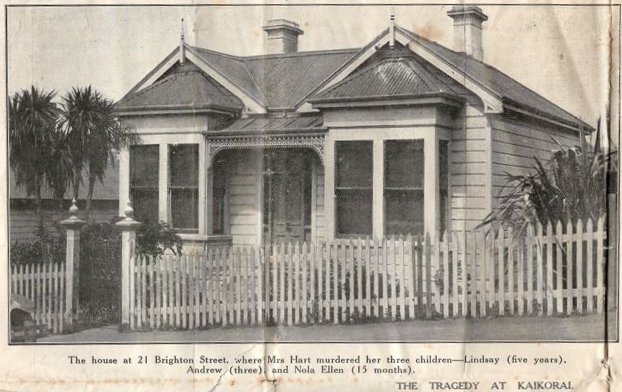
VICTIM OF DREAD DISEASE
(NZ Truth , Issue 1056, 18 February 1926, Page 7)
Source - National Library of New Zealand - Papers Past
(From "Truth's" Special Dunedin Representative.)
The last sad chapter in one of the most shocking tragedies known in New Zealand closed last week, when Mrs Ellen Hart, charged with having murdered her three children at Roslyn on November 9, was found not guilty on the ground of insanity.
ACCUSED, who had to be assisted into the dock, wore a neat navy blue costume with a black toque pulled well down over her face. On the Judge giving permission for her to be seated, she 'sank limply on to the form, and bent forward in such a way as to be out of sight of those in the body of the court.
She toyed nervously with her handkerchief throughout the trial, and used it frequently on tear-drenched eyes. For the defence Mr. J. B. Callan did not exercise his right of challenge, but the Crown did so in three instances.
"One couldn't imagine anything more shocking than the ghastly crime of a mother killing' her own children—quite defenceless children," said the Crown Prosecutor in opening.The only possible defence was that of insanity, and the life of accused might depend on that point.
The Act stated that "everyone is presumed to have been sane at the time of committing an offence until the contrary is proved," and the jury would have to concentrate on the accused's mental condition.
Was it conscious act?Solely for" the purposes of observation, accused had been taken to Seacliff Mental Hospital, and the full facts concerning the results of that observation would be placed before the jury to help them in coming to a decision.
Did Mrs. Hart know that she was killing her children, and did she know it was a criminally wrong thing?
"I've Killed My Kids"The first witness called was Margaret Ufton, who has been a neighbour of the Harts in Brighton Street, Roslyn, for 14 months.
On the morning of November 9 last she heard something falling on the roof not long after. 8 o'clock.
On going out of the back door she heard Mrs. Hart calling out: "Mrs. Ufton, Mrs. Ufton !"Witness ran to the fence, and on inquiring what the trouble was, got the answer: "Come quickly."
Mrs. Ufton ran round into Hart's place and saw Mrs. Hart leaning against the door on the back landing.
She had a man's coat over her shoulders, and there was blood on her arms, her face, and her stockings while there were three slight wounds on her neck.
When asked what she had done she said: "I've killed my kids; yes, the whole lot of them, and I did love those kids."When taken from the scene of the tragedy into Mrs. Ufton's home she said: "We had an argument last night. He told me that he did want me, but I couldn't stay on his terms."
When asked where her husband was, she replied: "Wilkie Road, Kensington; but I left a note."
She also said: "I suppose I'll hang for this."Mrs. Ufton and her husband then went into the Harts' house, and what 6 they saw made them sick with horror.
Strapped in its little pram in the front room was the 15 months, old baby, Nola, dead from a horrible wound in the throat.Huddled together on the kitchen floor were Andrew, aged 4, and Lindsay, aged 5, with wounds in their throats similar to that inflicted on the baby.
"What impression, did Mrs. Hart give you as a mother?" asked Mr. Callan of witness, who replied that "She seemed to be very fond of her children."
The first witness called by the defence was Dr. Hall; a specialist in eye, ear, and throat diseases.
He examined Mrs. Hart on February 6 and found that she had not standard vision. The right eye had lost nearly half of its visual efficiency while the left one had lost 15 per cent.
There were two causes: (1) Cloudiness of the front of each eye; (2) chronic disease, now inactive, of the optic nerve in each eye.
The history of these diseases was quite definite, and there was no doubt that hereditary disease was the cause of them."I thought," said witness, "that under the circumstances she was abnormal, in that she showed no sign of emotion when I questioned her about the children.
"She was quite cheerful and unimpressed by the position she was in." Henry Meredith Buchanan, until recently medical superintendant at Seacliff, first saw Mrs. Hart at Dunedin Hospital on November 10, when she told him that for four or five weeks she had felt "very absent-minded."
On the morning of the tragedy she had a feeling as though everything was pulling her down."On the morning of the 24th, he saw her in prison, when she was eating a very big dinner; "one that I couldn't have tackled myself."
She was confused, and dazed, and couldn't tell him or the proceedings in the Magistrate's Court the day before. When she arrived at Seacliff on December 2, he saw her again and found that her interests were superficial like those of a young child.
He submitted her to an intelligence test, which proved that she had the intelligence of a girl of 12, whereas the average adult had the intelligence of a girl of 16.The first clear recollection she had of the tragedy was when she tried to cut her own throat.
It was in witness's opinion that she committed the ghastly crime while in the grip of an uncontrollable impulse, but whether she was aware of what she was doing he was unable to say.
His Honor: Could you say whether she knew that she was cutting the throats of her children and not those of sheep, for instance?Witness: I simply could not say.
"The Cruellest Thing"Dr. Marshall Macdonald saw Mrs. Hart while she was in Dunedin Hospital and found no sign of remorse or emotion.
He next saw her in prison after she had made an appearance in the lower court and asked her how she had got through the ordeal.
She said she was surprised at the evidence,: much of which was new to her.She was shown a picture of her baby in the: Otago "Witness" and she characterised it as "the cruellest thing they had done."
In the course of conversation she told witness.: that her recent conduct had been so abnormal' 'that she was ashamed of herself a symptom that was not unusual in those developing mental trouble."
When questioned concerning the order in which she killed the children, she said that the baby was first, but she couldn't remember about the boys.In summing-up, his Honor said it was clear from the evidence that accused did kill her three children; the only thing the jury had to decide was whether insanity had been proved.
Judge's QuestionsIf they were satisfied that the defence of insanity was established he wanted to ask them the following questions:
(1): Was the accused insane at the time she killed the children?It took the jury only a few minutes to record a verdict of not guilty on the ground of insanity, and accused was ordered to be detained in Seacliff Mental Hospital.
(2): If she were insane, is she acquitted of the charge of murder
on account of insanity?