Kaikorai & Roslyn Cable Cars
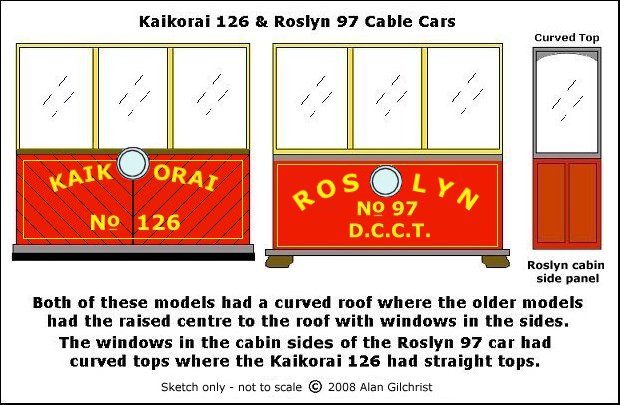
Cable cars came in many designs with most being variations of others. The early models came with a raised roof section complete with windows at the sides to allow light into the drivers (gripman’s) compartment. Later cable cars had a curved roof instead of the raised roof. On the Kaikorai line the first five cars were the early style and when a sixth was added it had the curved roof style. The first cars were numbered 1 to 5 and of course the later one was number 6. When the Dunedin City Council took over this route the cars were renumbered 121 to 126.
There were a number of different versions when it came to the Roslyn cable cars. While they appeared the same to a casual observer, closer inspection shows significant differences in the designs. In the sketch above I have shown one cable car from each route, Kaikorai and Roslyn. I should state here, to avoid confusion, that the Kaikorai cable cars ran from the Octagon to Nairn Street, Kaikorai – the Roslyn cable cars ran from Rattray Street to Frasers Road, Kaikorai.
All of the Kaikorai cars had diagonal T & G front and rear panels where the Roslyn cars had what appeared to be a plain front panel. The raised roof on the Kaikorai line cars had 7 panes of glass per side, where photographs of some of the Roslyn cars have only 4 glass panes per side. By contrast, photographs of the Mornington cars mostly show no windows at all in the top section of the roof with the exception of the Maryhill route.
The first Kaikorai cars had 5 window panes across front and rear where as far as I can see the Roslyn cars started with only 3 window panes front and rear. Kaikorai later changed to 3 pane windows. Other differences in the Roslyn cars include curved tops to the front/rear windows on some and straight tops on others where the Kaikorai line had only straight tops. Similarly, there were differences also to the cabin side windows with some having the straight tops and others with curved tops.
Note also the differences at the base of the cable car fronts, Kaikorai cars were straight across where the Roslyn ones had what appeared to be ‘feet’ which were actually covers for the ends of the side ‘running boards’ for the passengers who traveled standing along the sides. As well as this, the handles outside the cabins on all the Kaikorai cable cars were either vertical or diagonal - on the Roslyn versions with curved roof the handle next to the side seating was in a curved 'L' shape.
Where all these cable cars ended up is probably not totally clear but my guess is that the different features on each would help to establish where they originated.